Illuminated letters
With illuminated letters, each character is made as its own body and fixed to the facade individually. That is more work than a sign — and the reason the lettering reads so differently: it sits on the wall rather than on a panel, casts shadows in daylight, and works as a shape even unlit.
We design, build and install illuminated letters for facades, entrances and interiors across Mecklenburg-Vorpommern. Size, depth and fixing are set to suit the logo, the light effect you want and the mounting situation.
Options and variants
The most visible difference is where the light goes:
-
Front-lit – The face of the letter is lit. The classic build and the easiest to read from a distance; at night the lettering is still lettering.
-
Halo-lit – The face stays closed and the light escapes behind, drawing the outline onto the wall. Quieter and more considered, but it needs a suitable substrate for the halo to read.
-
Combined – Face and back both lit, often in different colours. Worth it where a logo is lettering plus a symbol and the two should read differently.
-
Unlit – Solid letters without light, for reception, a meeting room, or anywhere nobody passes after dark.
Then there is the fixing: letters can sit flat on the substrate or stand off the wall on spacers — the latter is a precondition for halo lighting and gives more depth even unlit.
Planning and design
The first step is checking your logo. We look at whether the lettering holds up as individual characters: how narrow the thinnest parts are, how tight the counters of a, e and o are, whether characters touch, and whether there are gradients or effects that cannot be translated into a physical body. That check ends either in a green light or in a specific suggestion for what should be adjusted so the logo stays recognisable.
A vector file works best (PDF, SVG, EPS or AI). If all you have is a JPG or PNG, we check whether the quality is enough for the project; depending on the source, redrawing is the better route. If no logo exists at all, we design one.
After that, size, spacing and depth are placed on the actual facade and presented as a design. Photographs and rough dimensions are enough for the enquiry; on suitable projects we check measurements and substrate on site before production. Manufacturing starts after approval.
Production
Every letter is made individually. The lit faces are usually acrylic — PLEXIGLAS® GS LED, for instance, which is made for evenly lit surfaces. Returns and backs are aluminium or PVC depending on the build, and on size, weight and mounting position.
Lighting is LED, typically 12 V technology; for the power supply we use units suited to the installation, among them Mean Well. On outdoor installations we choose components for the particular mounting situation. How densely the LEDs are fitted follows letter size and the brightness wanted — too little light looks patchy, too much eats the outline.
Installation
Individual letters are set individually, and that is exactly where the quality of the installation shows later: letter spacing, a shared baseline and the distance from the wall have to hold across the whole run. We align the lettering on site and fix it to suit the substrate.
With halo lighting the distance from the wall is part of the design rather than only part of the fixing — it decides how wide the halo falls. The power feed and where the driver sits are settled before installation, so no cable ends up visible that nobody planned for.
Typical applications
-
Shopfronts – The company name above the entrance, sized to the width of the facade.
-
Restaurants and cafés – Front-lit for reach from the street, often with LED neon in the window as well.
-
Reception and meeting rooms – Often unlit or halo-lit; here the effect from two metres matters, not from thirty.
-
Offices and practices – A restrained presence at the entrance, legible without light too.
-
Trade and workshops – Large lettering on unit walls, where visibility from the access road is what counts.
Why OSTSEE Werbeagentur
It starts with a conversation about the location, the budget and what the sign actually has to do. That becomes a design you see before anything goes into production. We build to that design — and we fit it ourselves, rather than handing it to someone who never saw it.
Because all four steps happen in house, there is no point where responsibility changes hands. If something needs adjusting, you ring one number.
Completed projects
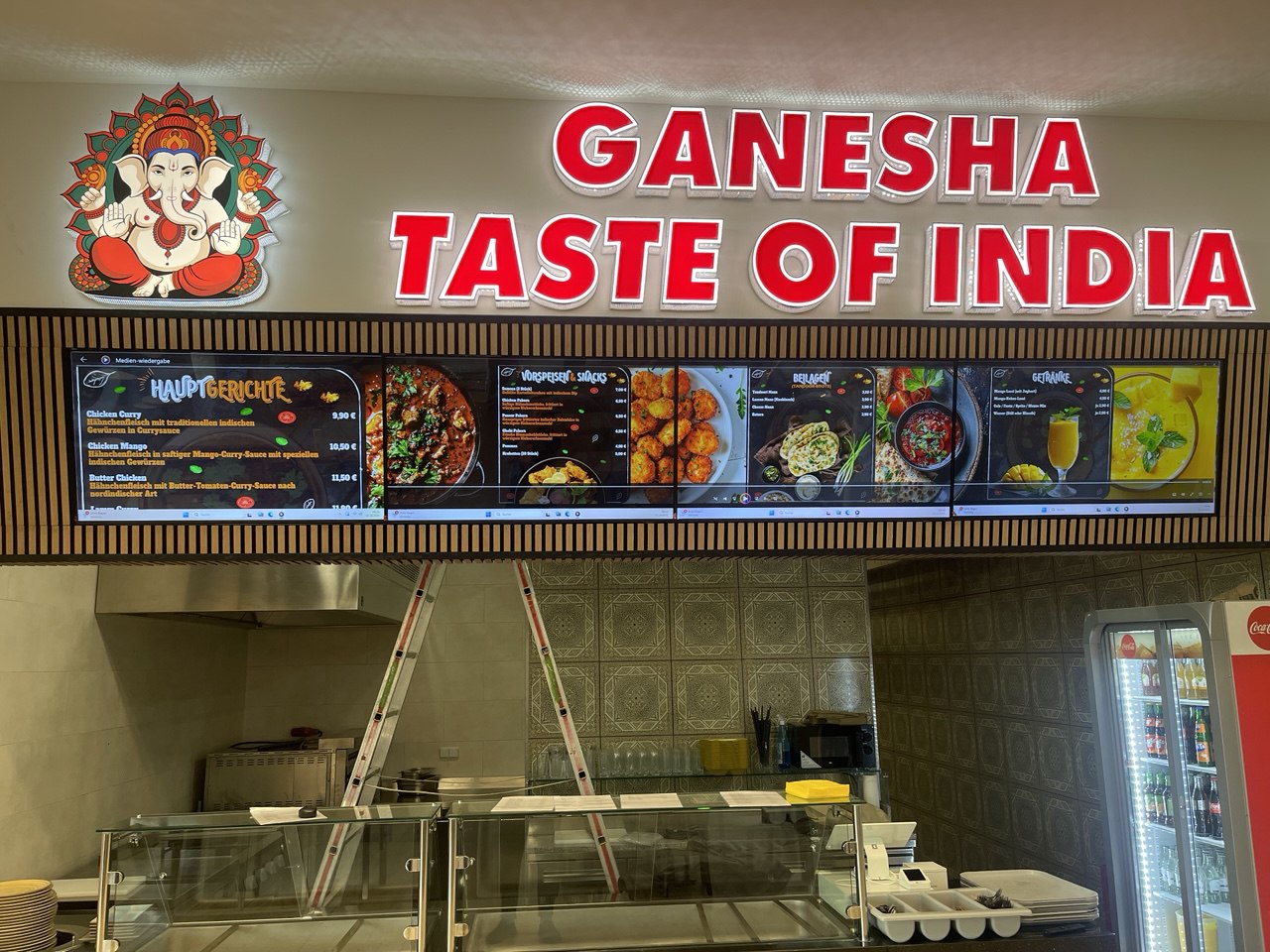
Illuminated Letters & Digital Menu Boards for Ganesha Taste of India
For the Indian restaurant Ganesha Taste of India we produced bespoke 3D illuminated letters and fitted them on site. We also installed digital screens and presented the menu on them in a clean, contemporary design. The result: outdoor signage that stands out and a digital menu that keeps working day and night.
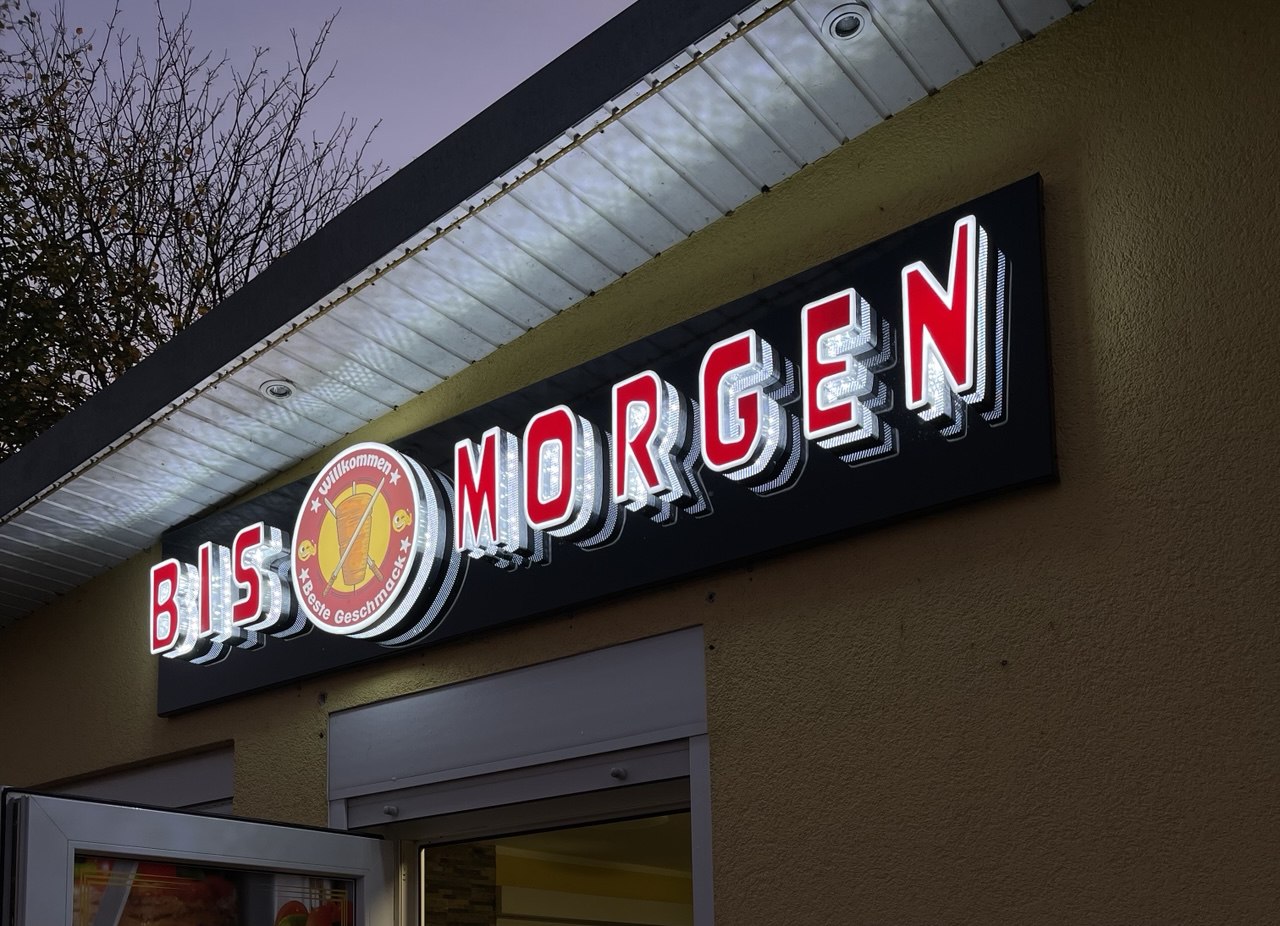
3D Illuminated Letters for the Bis Morgen Kebab House
For the kebab house Bis Morgen we designed, produced and installed made-to-measure 3D illuminated letters. The result is outdoor signage that carries well and draws attention day and night.
Frequently asked questions
What do illuminated letters cost?
The price follows letter height, the number of characters, depth, material, the type of lighting and the mounting situation. A short piece of lettering at eye level is a different job from a long name on the first floor. With the logo, the width you want and a photograph of the facade we can price it properly.
Can you build our existing logo as illuminated letters?
Usually, yes. We check first whether the shape holds up as individual characters — very fine lines, tight counters or colour gradients do not translate one to one into a physical body. If something has to be adjusted, we show you what that looks like beforehand.
Which files do you need?
A vector file is best: PDF, SVG, EPS or AI. If you only have a JPG or PNG we look at whether the quality is enough for the project; at low resolution, a clean redraw beats an automatic conversion.
What is the difference between front-lit and halo-lit?
Front-lit means the lettering itself is lit — that reads best from a distance. With halo lighting the letter face stays closed and throws a halo onto the wall; quieter, but it needs a suitable substrate and some distance from it.
Do illuminated letters work indoors?
Yes, and indoors less is often more: in a reception or meeting room, unlit or halo-lit letters usually look better than brightly front-lit lettering.
How large do the letters have to be?
That follows the reading distance and the facade width available, not a fixed rule. We place the size on a photograph of your facade in the design, so the effect can be judged before anything is made — and on suitable projects we check the measurements on site as well.
Do you handle the installation?
Yes. We align the letters on site, fix them to suit the substrate and make the connection, as far as it is part of the job.
Can existing letters be replaced?
Yes. Existing signage can be removed and replaced with the new lettering; both can be done in one visit.